Light on the Rock Blogs

The blogs are short articles, almost like a “sermonette” compared to a sermon. They are on a variety of topics, please enjoy.

Cybercrime - tips to avoid cybercrime

  1. Cybercrime is real. Municipalities, corporations, government agencies and people just like you can get viruses, malware and even ransomware. Ransomware is particularly dangerous in that it encrypts all of your data so it can’t be opened or read. Victims will often pay heavy sums to get the “antidote”. I have a friend who works at CDC whose elderly mother fell for this trap and ended up paying $300,000, her entire savings in the scam.
  1. Make sure your internet connection at home is secure using a strong password (at least 8 characters including special characters like ! ^$). Do not use the same password for all of your online accounts, especially banking. If it’s been more than a month since last changing passwords, it would be wise to change them all now since there have been massive cyber break-ins that could affect you – with Amazon, Google and Facebook and many more, for example.
  1. When shopping online, make sure before you purchase anything to verify the connection is secure, with the address showing: https and a small padlock icon in the URL address bar.
  1. Keep your devices (computers, laptops, tablets, cell phones) up to date. These updates often include security patches and are good defenses from viruses, malware, ransomware and other online threats.
  1. Only login to your banking, credit card or other financial online services at home or work where you have a secure connection. Never access your financial information at a public location such as a coffee house or even a hotel on any device, including your cell phone. Your internet connection in public locations is often not secure and your username/passwords can easily be stolen. Don’t take the chance.
  1. Watch out for phishing scams. You might get an email that concerns you about an unknown purchase, a request to reset your username/password or anything that might seem suspicious. 

  2. Never open any attachments such as a pdf, zip file or Microsoft office document from unknown sources as these might contain macros that install malicious software. Also, do not click on any links from untrusted senders. These can take you to sites that download malware or viruses without being detected. Always check the email address of suspicious senders. Often, it is unrelated to the content of the email. For example, you might get an email from FedEx, Apple or Amazon, however the senders email address is: This email address is being protected from spambots. You need JavaScript enabled to view it.. The domain name should be the same as the company mentioned in the email.
  1. Especially if you’re on Facebook, do not share information about pending vacations, trips or anything personal online. If a criminal knows your plans they can find where you live and break into your home when you are away. It’s also best not to post your birthdate on public sites, or names that could be used to help crack your passwords, i.e., be cautious about using names of pets, or nicknames of grandchildren or children, etc.
  1. Your friends on Facebook and other media may ask you to copy and paste something they found elsewhere and now want you to do the same. The problem with this is that all too often those oft-shared posts can have malware and computer viruses that can infect your computer and the ones with whom you share!  I recommend you stay away from these kinds of invitations. 
  1. Never give any PII (Personal Identifiable Information) on the phone, including your birthday, social security number or any banking information. No government agency will ask for this information. In addition, the IRS will never email you regarding you filing status.
  1. Don’t throw your personal information in the trash without first shredding it, tearing it up or blocking out sensitive information with a marker.
  1. Check your credit card statements each month and immediately report any unapproved activities.
  1. Windows 10 offers Windows Defender that should protect your system in real time, however that service can be compromised. A good, inexpensive alternative is Malwarebytes that can protect your computer and periodically scans your computer for any threat. While PC’s running Windows are the most targeted operating systems, Mac OS is also vulnerable as well if you do not take precautions.
  1. Finally, if you think you are the victim of a cybercrime, Do Not Panic. Shut down your computer and call an IT specialist for help.
Continue reading
4
  2515 Hits

Personalize God’s love for YOU

As we prepare for Passover and the days of Unleavened Bread, and examine ourselves so we take the Passover in a worthy manner, I hope all of us are focusing on a few things I’ll hi-lite here. Please take time to personally review each scripture in your own Bible. As we gather and feast on Messiah, there’s a lot to ponder.

*** PERSONALIZE your Passover. It wasn’t done just for the whole world, though that’s true too. Look at the examples of scripture, like how Paul says Christ “died for ME” (Galatians 2:20). The Israelites were told to tell their children that Passover is about what God “did for ME” (Exodus 13:8-9). FEEL those verses. Know God chose YOU and died for YOU through Christ. In Exodus 12, being under the blood of the lamb saved their lives. Today, being under the blood of Messiah – saves us for eternity! Hallelujah.

Make this real. Make it about what God did for YOU, just you – and then we know of course that he did it for everyone else who will accept him as well.

** Look at the SPIRITUAL meaning of everything you are doing.

The blood of the lamb is the blood of the Lamb of God. Putting out leaven is more about focusing on surrendering and giving up our remaining life behavior and thought patterns that are contrary to God’s Way. Throwing out leaven is really pointing to repentance – and leaving the old way, getting all of it out of our lives. Repentance is proving you’re sorry for your sins by throwing out the old patterns – the point of deleavening.

It makes little difference if we found and removed every crumb of leaven – but we still sinned with hardly a fight. We got drunk this week, or we looked at porn - again, or lost our temper – again, or pigged out as a glutton would, or were lax on keeping the sabbath day holy and set-apart. It makes little difference if we emptied the cupboards of leavened products but continue to shack up instead of honoring your partner and GOD -- and coming into a covenant marital relationship instead of living in sin.

DO TRUE deleavening, in other words, and put out the sinful ways we each still have. And really ultimately, we have to come to Yeshua and ask him to wash us thoroughly in his blood and to keep washing us thoroughly. It’s an ongoing activity! (1 John 1:7 is in the ongoing present tense – “cleanses”).

So you looked into every crevice of your couch and chairs and under cabinets – so what, if you or I continue to wallow in self-pity, worry, anxiety or fear – instead of trusting in our King, who has offered to take all of that from you, if you would just surrender it to Him.

So personalize it. Verbally with your lips and even more so with your heart – recognize Yeshua as the object of everything we do at Passover season.

Don’t keep this Passover with “old leaven” – old sinful habits we hang on to.

1 Corinthians 5:8 -- “Therefore let us keep the feast, not with old leaven, nor with the leaven of malice and wickedness, but with the unleavened bread of sincerity and truth”.

Sincerity and truth aren’t pieces of bread – but Paul is pointing us to the spiritual point of all that we’re doing. So he speaks of the unleavened bread of sincerity and truth. It’s way beyond bread and wine and leavened bread or matzah or vacuuming our house.

Remember Yeshua said, “this is the NEW COVENANT in my blood which is shed for you” (1 Cor. 11:25). He also reminded us – that in the new covenant – our focus is “in remembrance of ME” – of Christ. The Exodus 12 Passover pointed to Yeshua. Remember HIM – much more than the symbols of Ex. 12.

LOOK TO Yeshua in all of us. Rejoice in his victorious resurrection. It is by his LIFE that we are saved. We’re forgiven by his Blood, but saved by his life, being lived anew in you (Romans 5:10-11).

Spiritual meaning, focus on that. When you drink of the wine, remember the Bible also focuses a lot on “the CUP”. Drinking of one’s cup meant willingly accepting what God has in store for each of us – whether it seems good or bad. Even Yeshua, in the garden of Gethsemane, asked if there was any other way than to drink of that cup – but always ended it with our perfect example of “not my will, but yours be done.” (Luke 22:41-44).

So as you look for leaven, look for true leaven of hypocrisy, of malice and wickedness that remains in your life; items you haven’t surrendered yet. Where are we still hypocritical?

*** Passover is a memorial of God’s RECONCILIATION with you – even though he opened the way while you and I were still ungodly sinners. He died for the ungodly – including you and me (Rom 5:6-11 – please read it).

If we don’t forgive and reconcile with everyone who has issues against us, or we have issues against them – our prayers at Passover won’t mean much, frankly. Reconcile with anyone you’re not at peace with. Maybe your daughter, your son, your husband, your father, your mother – your neighbors, your work associates, anyone you are not at peace with.

Good scriptures to review: Romans 5:9-11; Matthew 5:23-24; Matthew 6:11-14. I’ll have a sermon soon on Reconciliation with everyone possible and forgiving everyone with whom you’re at odds.


As you wash other’s feet this year – remember Yeshua already washed his/her feet – and yours too. You’re just acknowledging God has already cleaned them up, and you as well. It’s more than just being a humble servant.

*** Be SURE you EAT unleavened bread each day, focusing on what that pictures! FEAST ON MESSIAH! He’s what the bread pictures.

The Passover season and days of unleavened bread is not just about NOT eating leavened products – but EATING unleavened bread. That pictures the life of Yeshua, the bread from Heaven (John 6). Again, look at the spiritual meaning! This is much more than just eating matzah for a week.

We all want the resurrected Jesus living in us more and more. With every piece of unleavened bread, remember – and say in your heart, “Dear Savior, my beloved king, come and BE my new life. We are what we eat. I want to fully devour your way of life and I invite you as my Savior – not just one time but day by day! Yeshua, BE my life. I want to FEAST on you during this special time. I love what you’ve done for me, - yes for ME --, and I praise you Father in heaven for resurrecting your Son, my King! Now may I glory in his resurrection being lived out anew in me.”

As you eat the unleavened bread, remember the righteousness you seek is not what comes from your own obedient actions now – but the righteousness that is from God, by faith, as HIS GIFT (Rom 5:17) to you. That’s what the UNLEAVENED bread pictures. And of COURSE, as I’ve been saying, surrender and change and obey as well.

But in fact, we don’t want the righteousness that comes from our own efforts (read Philippians 3:8-11) but that which is from God by faith in Christ’s life. ALL our righteousness is Christ. Philippians 1:11 says “…being filled with the fruits of righteousness that are by Jesus Christ, to the glory and praise of God” – not to your glory for all you have done.

Sure – unleavened bread also pictures – as we always hear – humility, and not being all puffed up. But in a nutshell, we’re really picturing a new life; Yeshua is now our life and our righteousness. See also Colossians 3:1-4 again.

I have several sermons on God’s righteousness you can find on this website. And please read these verses below, also.

** Romans 9:30-33; Romans 10:1-4.

** Romans 3:19-26. Verse 20 – all the law-keeping you can do won’t make you righteous enough. Just ask Job. V. 25-26 – God wants us to see HIS righteousness at work in us, not our own attempts at it. Then read Romans 4:20-25 – Abraham’s faith resulted in God’s righteousness being imputed to him, but not to him only, but to us also.

***REMEMBER TO ALSO BE FIGHTING THE GOOD FIGHT of faith. I’ll give a full-fledged sermon on just this magnificent point: remember we’re in a WAR against evil spirits. We are to be AWARE of that and fight HARD.

This includes bringing every thought into captivity to the obedience of Christ (please read 2 Cor. 10:3-6). TO do that, we have to be into God’s word enough that clear Biblical teaching comes to mind with every errant thought. We recognize the attack – often coming as something we’d carnally like to do – capture it, demolish it with the sword of the spirit, which is the word of God (Ephesians 6:17-18), and then continue to dwell on what GOD says to you about that thought. Think on GOOD things. Let’s get off the negatives, the worries, the fears.

Paul’s not fooling around here. It’s a real war. And in the end, he declares he has “fought the good fight, finished the race, kept the faith”,   (2 Timothy 4:7-8). He goes on to say he was certain of receiving the crown of righteousness and that we all should look for that too.

So have a wonderful Passover season. Know God would do all of it, even just for you.

Continue reading
8
  3176 Hits

Valentine’s Day – why I don’t participate

OK, I’m way too late posting this for this year to have any effect but hoping it will help more of you next year understand why many of God’s children do not get involved in most of the world’s holidays - - yes, including seemingly innocent Valentine’s Day. Some of you have kept it for years and may fear having to try to explain to loved ones why you won’t keep it any longer. If you come to that conclusion, do so well before Valentine’s Day next year at least.

Remember we are told to come out of Babylon, this world’s system led by the god of this world Satan (Revelation 18:4). “Coming out” will include no longer participating in its cherished holidays if they go against God’s ideals. So I don’t keep Valentines, and add to that – New Year’s Day, Easter, Halloween, and Christmas.

I saw a Facebook post from Maria Brown about Valentine’s Day. I’ll be the first to say, that like many of the other holidays rooted in paganism, I realize we don’t follow or keep the original ways the day was kept. But please also remember, that the practice of re-labeling pagan days, does not change its roots!

Most of the remainder is Maria Brown’s write-up on the day.

Is Valentine's Day God Blessed?

Valentine’s Day seems so innocent and beautiful! After all it is a time to show love and appreciation to that very special someone with flowers ,candy and small gifts. But is it what Jesus would do?

The history of Valentine’s goes back to pagan practices of the Roman sexual fertility festival of Lupercalia. Lupercalia was an ancient, possibly pre-Roman pastoral annual festival, observed in the city of Rome from the 13th to the 15th of February to avert evil spirits and purify the city, releasing health and fertility. This Roman festival was supervised by a corporation of priests called the Luperci.

The origins of the festival are obscure, although the likely derivation of its name from lupus (Latin: “wolf”) has variously suggested connection with an ancient deity who protected herds from wolves and with the legendary she-wolf who nursed Romulus and Remus. As a fertility rite, the festival is also associated with the god Faunus (Pan).

Each Lupercalia began with the sacrifice by the Luperci of goats and a dog, after which two of the Luperci were led to the altar, their foreheads were touched with a bloody knife, and the blood was wiped off with wool dipped in milk; the ritual required that the two young men laugh. The sacrificial feast followed, after which the Luperci cut thongs from the skins of the sacrificial animals and ran in two bands around the Palatine hill, striking with the thongs at any woman who came near them. A blow from the thong was supposed to render a woman fertile.

In 494 CE the Christian church under Pope Gelasius 1 appropriated the form of the rite as the Feast of the Purification. ( Encyclopedia Britannica)

The wicked ruler Nimrod was the origin of the legend of Pan. A wolf hunter and strong man.

Genesis 10:19 “He was a mighty hunter before the LORD: wherefore it is said, ‘Even as Nimrod the mighty hunter before the Lord”.

“My Valentine” comes from the practice of during the Lupercalia women would put their name in a box and which would be drawn out by the city’s bachelors to pair off for sexual immorality for the coming year. Sometimes (not usually) these ended in marriage later.

The early Catholics wanting to convert pagans adopted the pagan practice along with other pagan celebrations. But changed them to be more mellow giving them new names.

But Jesus ( Yeshua) would not celebrate this day because we are instructed in Jeremiah and other scriptures not to learn the ways of the heathens. God has His own holyday celebrations in Leviticus 23.

Jeremiah 10:2 “Thus saith the LORD, ‘Learn not the way of the heathen, and be not dismayed at the signs of heaven; for the heathen are dismayed at them.”

MARIA BROWN

Thank you, Maria, and History channel. Back to Philip writing now – so though these days may seem fun and innocent enough, I will not participate in them. God wants us having nothing to do with pagan holidays. It’s that simple. We are to come out of Babylon – the moniker for this world’s system.

You can Google what was written above and see it’s all there in the history channel. We didn’t make all this up.

https://www.history.com/topics/valentines-day/history-of-valentines-day-2

And Cupid? The fat little naked cherub boy who shoots golden arrows of love. That’s all rooted in paganism and pagan gods as well. Here’s what this source says, underlines are mine for emphasis.

Cupid is often portrayed on Valentine’s Day cards as a naked cherub launching arrows of love at unsuspecting lovers. But the Roman God Cupid has his roots in Greek mythology as the Greek god of love, Eros. Accounts of his birth vary; some say he is the son of Nyx and Erebus; others, of Aphrodite and Ares; still others suggest he is the son of Iris and Zephyrus or even Aphrodite and Zeus (who would have been both his father and grandfather).

According to the Greek Archaic poets, Eros was a handsome immortal played with the emotions of Gods and men, using golden arrows to incite love and leaden ones to sow aversion. It wasn’t until the Hellenistic period that he began to be portrayed as the mischievous, chubby child he’d become on Valentine’s Day cards.”

So why should I participate in a day – as sweet as it seems – that goes back to the fanciful Greek god of love, Eros? Now you know why. Remember too, that Satan presents his ways to us as beautiful, for he comes as an angel of light, but he’s really all about darkness.

2 Corinthians 11:14-15 “And no wonder! For Satan himself transforms himself into an angel of light. Therefore it is no great thing if his ministers also transform themselves into ministers of righteousness, whose end will be according to their works.”

Continue reading
7
  2942 Hits

Should I vote in 2020?

2020 2

There has never been a time in the history of the United States where two political candidates for president represent the polar opposites of ideals, goals and a political agenda.

The surprise election of Donald Trump in 2016 has caused a major upheaval in the carefully laid plans of previous administrations. The veil has been pulled back to reveal hypocrisy, lies and lawlessness on a scale that is shocking. From the day President Trump was elected, the Democratic party started threatening impeachment and it seems for several career politicians this became their primary focus. There is a Deep State, men and women, committed to an agenda in defiance of the will of the American people and our elected President. Truly nothing is new under the sun, Jerimiah 11:9 speaks of a conspiracy in ancient Israel, much like today.

Media outlets have been exposed to their bias and fake news. The left-oriented news agencies now openly criticize and mock the President - and the Americans who voted for him. Trusted health organizations like the WHO have failed, their policies and recommendations influenced by their financial connections with China, the source of Covid-19. The result? America’s booming economy has come to a grinding halt in response to the Covid-19 pandemic.

Civil unrest, rioting, burning and looting in America’s major cities – for over 3 months now. The call to defund police, ICE and removal of correctional facilities from extreme Marxist groups like Antifa and BLM who practice and advocate lawlessness. Mayor DeBlasio sided with the radical extremists and he has shifted nearly 1 billion dollars away from the NYPD budget.

Fake News, Fake Politics, Fake Christianity and Fake Education have taken their toll. A shockingly high percentage of the rioters who are burning our cities are actually teachers!

We are living in ever increasing difficult times that will try all of us. This nation is wracked with fear, people even wearing masks inside a car or their homes when there is no evidence of any real protection. The healthy should never be quarantined, only the sick. Fear has corrupted common sense.

Looking at the Democratic controlled states and cities we see politicians capitalizing on Covid-19 fears forbidding church gatherings, however you are allowed to buy liquor, marijuana and protest in the streets – with or without masks.

There is a spirit of hate, divisiveness and racial tension moving across the land. We know where these spirits originate and who is behind it. Satan hates God, he hates us and he hates this country. The corrupt politicians, lying pastors, deceitful educational and health organizations, and violent rioters are being used by Satan and his demons to incite anxiety, hatred and fear.

The sins of this country have become progressively worse. New York has the highest rate of abortion in the country terminating 1 out of every 3 pregnancies. Yet this wasn’t enough for New York politicians and pro-choice activists who recently passed a law ensuring that even if the Supreme Court overturned Roe vs. Wade, abortion would be available, even up to the point of live birth. The passing of this bill was celebrated with cheers while Governor Cuomo ordered New York landmarks to be lit up in pink to celebrate this horrifying “victory”.

Let’s briefly look at what the Republican and Democratic parties represent in 2020. Then let’s ask ourselves if God really wants us to remain silent on such vital issues when He has given us this country with the liberties we have enjoyed.

Republicans:

  1. Lower Taxes
  2. Stop illegal immigration, drugs and human trafficking
  3. Strong economy, encouraging all Americans to be employed
  4. Strong national defense
  5. Fair international trade laws
  6. Protection of our Amendment rights, especially Freedom of speech and religion and the right to peaceably assemble and the right to bear arms (Amendment #2)
  7. Support for the Police and ICE and law and order
  8. Support the lives of yet-unborn boys and girls.

Democrats:

  1. Democratic Socialism
  2. Open borders, which encourages more illicit drugs & human trafficking
  3. Higher taxes and more regulation of business
  4. Health care and free education for all illegal aliens
  5. Forfeiture of all guns, especially handguns and AR-15’s
  6. Military cutbacks
  7. Reduced police enforcement, ICE and correctional facilities
  8. Support Planned Parenthood and ending the lives of millions more innocent little unborn boys and girls.

Antifa is a left-wing militant organization committed to achieving their objectives using violence rather than policy reform. While they claim to be anti-fascists, they try to achieve their objectives through harassment, militancy, physical violence and property damage. President Trump has declared Antifa a domestic terrorist group. As of today, August 29, 2020 if you enter antifa.com into a browser you will be redirected to Joe Biden’s campaign website: joebiden.com. Antifa supports Joe Biden, think on that.

As Christians, what are we to do? There are two paths with very different results that will affect every single American. 2020 is a defining year for our country and we can have a part of the outcome – we can use our American right to vote. In most states, you have up until October 3 to register to vote in the upcoming general election.

The Bible never mentions whether we should or should not vote in political elections. However, we do see Paul appealing to Caesar when it appeared that justice would not be served. He used a political right he had. We see the example of Esther, violating the king’s law and risking her own life to appear before him to save the Jews of her day from annihilation. She made a stand, she spoke up, she did something. She could have just as easily reasoned that she could just dismiss any necessary action since surely God could have taken care of the problem without her.

We see through God’s intervention that Joseph, Daniel and his three friends, plus Mordecai and who knows how many others held very high positions in their governments right there in ancient Egypt, Babylon and Persia, the very symbols of sin and evil. They used their positions to further the cause of right and good.

What about the understanding that God has a plan for all mankind, lives in eternity, knows all things and will work them out to His good will? What about the prophecies that show the demise of modern Israel due to our rampant sins? That is indeed true. Yet we also see the pagan city-state of Nineveh repenting (Jonah 3) and God’s judgement delayed for several generations. We also know that in God’s mercy He wants repentance and does not delight in the death of the wicked.

God likes to work through men and women, and often through very difficult times requiring courage, faith and action. Yes, action.

So I ask myself this question, what would I tell God if He asked me why did I not cast a ballot in this election? Since I can clearly discern between what is best for our nation and what will lead to the further weakening our country, why did I not take action to try and prevent the destruction of our people and our land? We know who weakens the nations, Isaiah 14:12.

And remember God judges us largely based on what He has given us. Can we really remain silent and not vote – or does God want his children voicing their strong objection against abortion and taking a stand for the defenseless unborns? Does He not delight in seeing us speak up and using our opportunity to vote to say we wish to obey his command to come together on sabbath to worship him?

To whom much is given, much will be required. We’ve been placed here at this moment “for such a time as this.”

Ezekiel 22:30 talks about God looking for one man to stand in the breach before Him, so he would not destroy the land. Could it be that God is giving each and every one of us that opportunity now as never before to stand in the breach, to let God know his people care? We may never have this opportunity again.

Continue reading
1
  2860 Hits

What "I Can Do All Things..." Really Means

All

By GUEST WRITER R HERBERT (see more of his writings at www.TacticalChristianity.org)

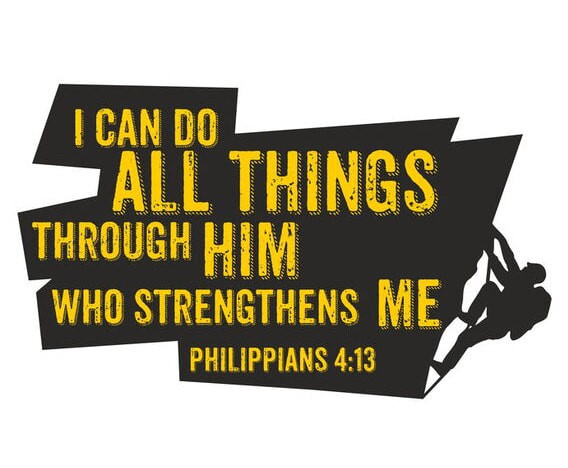
I can do all things through him who strengthens me” (Philippians 4:13)
 
It’s a verse we all know, a verse that quarterback Tim Tebow inscribed in his eye black, one that has been engraved on thousands of items of jewelry and printed on countless items of Christian merchandising.  But does it mean what most people presume it means? 

For many people this verse (and its slight variant “I can do all things through Christ who strengthens me” NKJV, etc.) has become a kind of Christian mantra, a spiritual guarantee that whatever we do will succeed if we act in faith. 

The truth is that Philippians 4:13 does not really say or mean anything of the kind. But what it really does say and mean can be infinitely more encouraging.

As with any biblical verse, “context is king.”  To understand what Paul had in mind with these words, we must look at the context in which he wrote them:

“for I have learned in whatever situation I am to be content. I know how to be brought low, and I know how to abound. In any and every circumstance, I have learned the secret of facing plenty and hunger, abundance and need. I can do all things through him who strengthens me” (Philippians 4:11-13 ESV).

The context shows us immediately that Paul was not talking about success in doing things, but about success in dealing with things –  the ability to accept and enjoy or endure (whichever is appropriate) whatever life may throw at us. 

The underlying Greek in which Paul wrote Philippians confirms this meaning. The Greek does not literally say “I can do all things” –  the word “do” does not appear in the verse at all. Rather, the words mean “I have strength for all things” –  in other words, “I can survive, deal with, handle, be content with, all things.”


The apostle tells us that he had fully experienced the positive and negative aspects of life –  “every circumstance” –  and he had learned that through the strength God gave him, he could successfully live through them all.
 
This is important.  Paul tells us he could not only survive the bad things with God’s help, but also the good things of life. Why would we need help in surviving the good things?  Simply put, the scriptures show us that both prosperity and poverty can be snares (Proverbs 30:8-9).  Although poverty can leave us bitter and even lead to stealing, prosperity can encourage complacency,  self-reliance and pride.  But Paul’s words show that with God’s help we can meet whatever circumstances we find ourselves in with a right attitude that does not distance us in some way from God.

As such, Philippians 4:13 has nothing to do with being able to accomplish goals or other things we may want to do in life. God certainly can help us with such things if it is his will, but Paul’s point does not relate to that fact.   Far more importantly,  Paul tells us that God can help us succeed in things that are far more vital than physical accomplishments - the things Paul was talking about. That is why the NIV translates this verse:  “I can do all this through him who gives me strength” (emphasis added).

Remember, too, that the apostle penned these words from a prison cell near the end of his life – hardly a position of success and accomplishment in physical terms. Nevertheless, Paul had learned that whether he  found himself in a palace or a prison cell, he could be content in the knowledge that God would help him to deal with it.

For Paul, “I can do all things through him who strengthens me” was not about performing well or fulfilling goals at the physical level,  but about achieving the things in life that matter the most. Philippians 4:13 is not about what we can accomplish with God’s help, but what God, through his help, can accomplish in us. 

Continue reading
2
  3446 Hits

The Worst kind of Pride

pride

It is often said that pride –  in the sense of self-elevation rather than what we call being “proud” of other people, such as our children, team, or school, etc. –is the worst of sins because self-oriented pride inevitably leads us to set ourselves up in the place of God. As has been wryly said, we become “self-made men or women who worship their creator.”

Scripture is so clear. Proverbs 6:16-19 lists seven things God especially hates. At the top of the list is “A proud look.”  And Peter tells us God resists the proud but gives grace to the humble (1 Peter 5:5). God can’t endure him with a haughty look and proud heart (Psalm 101:5).

Pride of this self-elevating type can manifest itself in many ways, but it invariably involves comparison – the way in which prideful individuals compare themselves to others.  The Gospel of Luke gives a clear example of this problem in the parable of the self-righteous Pharisee and the socially despised tax collector:

To some who were confident of their own righteousness and looked down on everyone else, Jesus told this parable:

“Two men went up to the temple to pray, one a Pharisee and the other a tax collector. The Pharisee stood by himself and prayed: ‘God, I thank you that I am not like other people—robbers, evildoers, adulterers—or even like this tax collector. I fast twice a week and give a tenth of all I get.’  But the tax collector stood at a distance. He would not even look up to heaven, but beat his breast and said, ‘God, have mercy on me, a sinner.’  “I tell you that this man, rather than the other, went home justified before God. For all those who exalt themselves will be humbled, and those who humble themselves will be exalted” (Luke 18:9-14).

There are several not-so-obvious things that we should notice about this parable in relation to pride.  While most Jews only fasted on the yearly Day of Atonement, the Pharisees added to the law of God by fasting before and after every annual festival throughout the year – or even more frequently.  The Pharisee in the parable, however, claims to fast twice each week.  This shows us the level of his pride in that he proclaims that he is even more devout than most of the Pharisees themselves.

But there is another aspect of the Pharisee’s behavior that reflects the nature of comparative pride.  The parable tells us the actual words that the Pharisee prayed – indicating that he “said” these words out loud rather than “thought” them (compare, for example, Luke 12:17).   

Public prayers were made twice each day in the temple – at the times of the morning and afternoon sacrifices.  At those times Jewish temple-goers would assemble in the “Court of the Israelites” directly outside the inner temple.  First the priest would perform the sacrificial offering of the day and then he would enter the inner temple area to offer incense. It was at that point that the Israelites outside would pray, out loud, while the priest made the offering on their behalf (Luke 1:8-10). 

When we realize that the Pharisee’s prayer was not thought, but spoken out loud, we see the deprecating nature of pride at its worst.  By saying “God, I thank you that I am not like other people—robbers, evildoers, adulterers—or even like this tax collector…,” the Pharisee publicly shamed the tax collector in order to enhance his own self-exaltation.

The situation described in the parable is a classic example of the way pride, in its worst form, puts down others in order to elevate oneself. 

C.S. Lewis described the phenomenon perfectly: “A proud man is always looking down on things and people; and, of course, as long as you are looking down, you cannot see something that is above you.”   As a result, the Pharisee prayed but did not see or really communicate with God. That is why, Luke tells us, Jesus taught this parable “To some who were confident of their own righteousness and looked down on everyone else” (Luke 18:9).

For most of us, pride is not expressed so blatantly or in such an obnoxious manner, but we must always be aware of the human tendency in this direction.   Pride can often be found in even seemingly innocent comparison.  That is why the apostle Paul wrote: “We do not dare to classify or compare ourselves with some who commend themselves. When they measure themselves by themselves and compare themselves with themselves, they are not wise” (2 Corinthians 10:12).

There are a number of tactics we can utilize to avoid this trap, but Paul himself gives us two that we can all put into use.  First, as the apostle wrote to the Philippians: “in humility value others above yourselves” (Philippians 2:3), or, as the NKJV translates this verse: “in lowliness of mind let each esteem others better than himself.”  This is the most fundamental deterrent to pride of any type, but especially comparative pride.

Paul gives us another basic principle in his letter to the Galatians. “Each one should test their own actions. Then they can take pride in themselves alone, without comparing themselves to someone else” (Galatians 6:4).   In writing this, Paul shows us that it is not wrong to be happy and thankful to have accomplished something or to have made progress toward our goals, as long as that is not done by comparing ourselves to others.  

Ultimately, the worst kind of pride is avoided when our self-concept is based not on how we compare to others, but how we compare to what God calls us to.  That is always a humbling thought and one that leaves no room for the growth of pride at all.

** ***

For more from R. Herbert – his pen name – go to www.tacticalchristianity.org   

Continue reading
0
  3495 Hits

Habakkuk 3 - Finding JOY in TOUGH times

Editor’s notes: I’m honored to introduce a new contributor to Light on the Rock blogs. Samantha Skiens is a graduate of Wheaton College with 2 degrees in Bible Theology and Ancient Languages with emphasis in Hebrew.  She currently teaches Bible Theology at a private Christian college in WA state. But what I like most about her is that this 22-year old obviously loves Yeshua and desires to be obedient to his commands. She brings some great and mature points from the often-overlooked short book of Habakkuk 3  – points which are so timely with the Coronavirus issues we’re all facing. Welcome Samantha.    

*** ********************    ****************************

Rarely do I write, and rarely do I post. But for some reason, inspiration has been striking me lately, and so I sit at my computer, typing away, when I should be grading the research papers my juniors just submitted this morning.

Some of you may be aware that this year has probably been the hardest year that I have had in a long time, if ever. I won’t go into all the details, but I want to share something the Lord has laid on my heart. Throughout this year, God has been high-centering me on a passage in Habakkuk—yes, one of those very small, rarely touched books of a collection called the Minor Prophets. Habakkuk was alive during the final years of the Southern Kingdom of Judah. He saw the rising threat of Babylon approaching on the horizon and knew what it would mean for his community and the last of God’s people (since Assyria had already taken out the Northern Kingdom). I personally love Habakkuk because of this unique feature: the prophet does not accuse Israel of any sins or wrongdoings, as many of the other prophets did. Rather, Habakkuk openly and refreshingly wrestles through his personal journey about whether or not God is truly good amidst the evil and tragedy in the world. I say “refreshingly” because these are thoughts many of us often have. 

In Chapter 3, Habakkuk begins by describing the gloriously terrifying presence of the Almighty. I’ll quote from the NIV.

Lord, I have heard of your fame;
    I stand in awe of your deeds, Lord.
Repeat them in our day,
    in our time make them known;
    in wrath remember mercy.

God came from Teman,
    the Holy One from Mount Paran.[b]
His glory covered the heavens
    and his praise filled the earth.

His splendor was like the sunrise;
    rays flashed from his hand,
    where his power was hidden.
Plague went before him;
    pestilence followed his steps.
He stood, and shook the earth;
    he looked, and made the nations tremble
.
The ancient mountains crumbled
    and the age-old hills collapsed—
    but he marches on forever.
I saw the tents of Cushan in distress,
    the dwellings of Midian in anguish.

After this humble acknowledgement of the power and presence of God, the prophet then appeals to God’s faithfulness. You can read Habakkuk 3:8-15 on your own.  It shows the fury and ferocity of our God when He moves against or for nations. 

By pausing to remember God’s power and faithfulness, Habakkuk concludes his short book with a message of hope. However, Habakkuk does not immediately rush to that hope; he acknowledges that hope is truly fostered in the space of trial, and it must withstand the immediate challenges he is about to face with Babylon. This is a crucial point!

16 I heard and my heart pounded,
    my lips quivered at the sound;
decay crept into my bones,
    and my legs trembled.
Yet I will wait patiently for the day of calamity
    to come on the nation invading us.

Though the invasion and captivity are to come, that imminent trial does not have the final say. God is just and will bring his justice even to the invading nations.  Habakkuk leads into the darkest hour for Judah’s history with a final message of hope and praise, with vital lessons for us all (Habakkuk 3:17-19):


17 Though the fig tree does not bud
    and there are no grapes on the vines,
though the olive crop fails
    and the fields produce no food,
though there are no sheep in the pen
    and no cattle in the stalls,
18 yet I will rejoice in the Lord,
    I will be joyful in God my Savior
.

19 The Sovereign Lord is my strength;
    he makes my feet like the feet of a deer,
    he enables me to tread on the heights.

Those verses can sound so nice when our lives are functioning with relative peace. Now, is the time to lean into the history and the lives of those who have weathered great winters before us. I close my eyes and imagine the situation of those during centuries past -- people in many different countries facing a range of atrocities and fears. That isn’t meant to glorify what generations past survived or diminish what we are experiencing today. The reality is that ALL go through difficult times. Rather, these moments of the present and those of the past are bound together by something deep; there is an inexplicable solace and hope found in the darkest of hours and deepest of pains.

I want to finish with one final note: Habakkuk mentions a thing called “joy.” He says in verse 18 that he will REJOICE in the Lord and be JOYFUL in God His Savior.

Though society portrays the two as synonyms, joy and happiness are two vastly different things from the viewpoint of God’s word.

Etymologically, happiness is based on one’s “happenings,” or the circumstances in one’s life. You might be happy because a situation is positive, and you might not be happy because it is negative.

Joy, on the other hand, is completely independent from one’s circumstances. Joy is accessed through something deep inside of us. It is eternal, not temporary; a huge difference.

Happiness comes and goes like the tide, but joy is constant. We, being very fickle and finite people, can find this eternal joy in one place, and one place alone: God. This explains why Paul writes in 2 Corinthians 7:14, “I am overflowing with joy in all our affliction,” or in Colossians 1:24, “Now I rejoice in my sufferings for your sake.” Happiness belongs to this earth. It can stem from the physical things of this world: food, drink, people, material items—maybe even toilet paper on the shelves at stores. Joy is of God’s Kingdom. Again, Paul draws this contrast in Romans 14:17, “The kingdom of God is not eating and drinking, but righteousness and peace and joy in the Holy Spirit.”

Joy stems from a settled assurance that God is in control. Habakkuk was not happy during his present day, facing the invading Babylonians and questioning God’s goodness amidst the terror of it all. But Habakkuk shows us that we can truthfully be unhappy about what’s going on around us,  but still have rock-solid joy in our hearts. Habakkuk shows us it was and is good -- to even question God in times of struggle; it is how we all must grow in our personal relationships with the Lord. In fact, relationship is of the utmost importance during this time. Religion will not stand when crisis hits; it is an institution (man-made), and underneath that definition, institutions can break.

Solid relationships, however, can withstand the shattering of society. Families and friends can stand by one another’s side when the world turns upside down, although even with human relationships, these can fracture in severe stress.  However, a strong relationship based on a deep love for God can never be ripped, stolen, or removed from us. Never.

In this light, let’s read once more how nothing can and nothing will separate us from the love of God. Not personal problems, not anything in this world, not this Covid-19 virus – nothing can, when we have established that firm relationship with our Maker:

Romans 8:37-39 from the CJB: “No, in all these things we are super conquerors, through the one who has loved us. 38 For I am convinced that neither death nor life, neither angels nor other heavenly rulers, neither what exists nor what is coming, 39 neither powers above nor powers below, nor any other created thing will be able to separate us from the love of God which comes to us through the Messiah Yeshua, our Lord”.

My encouragement for us all today, and I am sure, for many days ahead, is to rest and find rest in our relationship with our Lord. Life is always ultimately about having the right relationships.  For it is only through that relationship with our God our Father and Jesus Christ our Lord that we can tap into the eternal joy that Jesus offers.

Like Habakkuk, we might not always be happy, but we can most definitely be joyful.

Continue reading
2
  5498 Hits

BUT I CAN’T FORGIVE ‘THAT’

(Host’s note:  This beautifully worded blog is from a new contributor and writer to Light on the Rock blogs.  We welcome this daughter of God, who will go by “Newfie”. I hope you get as much inspiration out of it as I did. – Philip Shields)

“There is no witness so dreadful, no accuser so terrible as the conscience that dwells in the heart of every man.” Greek historian, Polybius (205 BC-118 BC)

Passover is almost upon us and when I saw this quote today it grabbed my instant attention.  How true!  Conscience can be a formidable thing when repenting and walking on a rocky road toward perfection.  ALL of us sin and have sinned and come short of God’s glory—eternal life. Romans 3:23 I think most of us know that even if we didn’t grow up Christian.

And the fact that we have a conscience shows, by itself, that God still considers us His “good” creation (Genesis 1:31) and has not hidden Himself from us (Yes He does separate Himself from sin but that is another topic) or taken all that is good from us..  (“If you seek me with all your heart, you will find me” (Deuteronomy 4:29/ Jeremiah 29:13)

“But my sin was SO HORRIBLE!  I JUST CAN’T FORGIVE MYSELF EVER!”  we might say.  “I am sitting in jail right this moment and will be here for the rest of my life!  How am I supposed to forgive myself for that?!”

Well, here is where the Power that you don’t automatically have by yourself comes in.  You have repented (promised the Eternal that you will not repeat that horrible action or those horrible thoughts), have turned from your previous way of life and recognized that your sins are UGLY in His sight. (Isaiah 64:6) but He still loves each of us enough that He gave up His one and only Son to die and pay for that ugliness. (John 3:16) With repentance He then promises to clean us.  (I John 1:9/ Psalms 51:2/ and my favorite, Psalms 51:10)


THEN He welcomes us into His House.  Psalms 23:6 says goodness and mercy will follow us and we will dwell in God’s house forever.  I will say “forever” means “forever’ so the time period would have to include now.  He welcomes us before His presence!

This would be hard to do if we were not also forgiving ourselves because His house is a house of rest.  (Hebrews 4::1-9) Although these verses contain many meanings with one of the main ones being a permanent fulfillment of ‘rest’ (eliminating all anxiety and self-incrimination while being filled with the fruits of the Spirit) they also refer to a rest that we can have in this life!

Jesus told the woman caught in adultery to go and don’t keep judging herself.  He said he was certainly not going to judge her because her accusers were gone.  For her accusers to be gone, she could not accuse herself.  He instructed: “... go and sin no more”.  (John 8:11—read the whole story in this chapter).

My request for all of us is to take God up on is promises.  One day at a time ask Him to remove our bad thoughts. (Matthew 6:11)   They are certainly Satan inspired. (Matthew 6:13) And to go forward through Passover with humility and great thankfulness for being cleaned up and forgiven by our Savior.

So go with solemn joy to Passover with a joyful, forgiven and clean heart – and take of his bread of his life, and drink of his cup.  All of this is possible because of what HE has done for you and me. We praise you, our Father.  We praise you, our Savior. 

Continue reading
0
  3117 Hits

The 80% Principle of Prayer


By R. Herbert

Not all prayer is asking for something, but a great deal of it obviously is.  When we do ask, do we pray mainly for our own physical and spiritual needs and concerns?   There is no doubt that it is acceptable to pray for these things – we have Christ’s encouragement to do so – but that is only part of the picture we find in the words of Jesus and in the New Testament as a whole.

Jesus certainly commanded us to pray about our own needs. “Give us this day our daily bread” lies at the heart of the Lord’s Prayer (Matthew 6:11), but we should never forget that all the petitions in that guide to prayer are for the needs of others – “us” – as well as our own.

Asking in Acts

If we continue in the New Testament and look at the Book of Acts, we find something very interesting. Acts continually speaks of prayer in the Church, but if we set aside the scriptures that simply tell us that the early church members prayed and we look only at verses telling us what the early believers were praying, in most translations we find only 2 verses in that book showing people praying for their own situations and 12 verses showing believers praying for the needs and welfare of others. This means that of the recorded prayers in Acts, some 83% are prayers on behalf of others rather than prayers for the individual who was offering the prayer.

If we have not thought about this topic before, the statistic may seem unexpected. Perhaps we would expect the ratio to be about 50/50 – prayer for others just as much as for ourselves. But the 83% prayer for others we find in Acts is a powerful statement of another way of looking at prayer – and the Book of Acts is not alone in taking this view.

Paul and Prayer

When we look at the writings of the apostle Paul, we find the principle corroborated.   Paul speaks of prayer some 50 times in his epistles. Apart from non-specific examples, when we look at the nature of the prayers Paul mentions we find only three instances of praying for one’s own needs. Seven times Paul speaks of praying generally; but in some 40 of the 50 instances (80%) where he mentions specific things being prayed about, we find him speaking of praying for others or urging people to do likewise. For example, Paul tells us that he and his fellow workers prayed constantly for the spiritual needs of others:

“Therefore we also pray always for you that our God would count you worthy of this calling, and fulfill all the good pleasure of His goodness and the work of faith with power, that the name of our Lord Jesus Christ may be glorified in you, and you in Him, according to the grace of our God and the Lord Jesus Christ” (2 Thessalonians 1:11-12).

And he urged others to continually do the same:

“And pray in the Spirit on all occasions with all kinds of prayers and requests. With this in mind, be alert and always keep on praying for all the saints. Pray also for me, that whenever I open my mouth, words may be given me so that I will fearlessly make known the mystery of the gospel, for which I am an ambassador in chains. Pray that I may declare it fearlessly, as I should” (Ephesians 6:18-20, etc.).

So the pattern we found in Acts where we are told what people were praying for is repeated in the epistles of Paul where he so frequently tells what we should be praying for. These facts should speak to us. It is not a matter of attempting to establish Christian practice through statistics. It is simply acknowledging that of the prayers recorded and commanded in the New Testament Church the great majority – somewhere around 80% – are prayers for others.  

Applying a Principle

That’s why we can think of this fact as the 80% principle of what we ask for in prayer. It’s an estimated number with no claim to being correct to the third decimal place, but it’s a rounded number with a clear message.   The 80% principle does not mean we should not pray for our own needs – and in some circumstances, of course, our own needs may be urgent and take full precedence in our thoughts. But the 80% principle opens a window for us to see how the early Church saw prayer, how Paul encouraged us to pray; and it gives added meaning to Jesus’ words that we pray for “us” in the plural.

We certainly don’t need to feel constrained to structure our prayers to a certain percentage in a certain way, but if we are growing more and more like the One to whom we are praying, the chances are that our prayers will become increasingly full of the needs of others and reflect our concern for them. If our prayers are growing in that direction and we begin to see the needs of others as usually greater than our own needs, we can trust that God will be pleased with our prayers – perhaps 100% pleased. 

R. Herbert, Ph.D., was trained in biblical studies and Ancient Near Eastern languages and archaeology. He writes for a number of Christian venues as well as for his websites at LivingWithFaith.org, TacticalChristianity.org, and FreeChristianEBooks.org.

Continue reading
2
  3648 Hits

Seven Biblical “Firsts”

In this post, we are not talking about historical first events such as the first sacrifice or the first building of a city that is mentioned in the biblical narrative, but the first appearance of terms that play vitally important roles in conveying the teachings of the Bible – words such as faith, hope, love, etc.  We have selected seven of these key concepts; seeing their first occurrences can be instructive as well as interesting. 

FAITH – Finding the first instance of the word “faith” in the Bible is not as simple as it may seem. This is because the Hebrew of the Old Testament has at least six words that can reflect different aspects of the idea.  But many of these words carry meanings such as “faithful” which really means some aspect of loyalty (Genesis 5:22, 24, etc.). When it comes to the concept of faith as “trust,” the first clear instance is found in Genesis 15:6 which tells us “Abram believed the Lord, and he credited it to him as righteousness” (emphasis added). Paul quotes this verse in the New Testament and translates it with the Greek word pistis – the same word he uses throughout his writings on faith.

HOPE – The first mention of hope is found in the book of Ruth. In Ruth 1:12 we find Naomi telling her daughters-in-law: “Return home, my daughters; I am too old to have another husband. Even if I thought there was still hope for me – even if I had a husband tonight and then gave birth to sons…”  Here, in hope’s first appearance in scripture we see the very real difference between faith and hope.

LOVE – Arguably the most important single concept in the Bible, the first mention of love in the Bible occurs in Genesis 22 when God tells Abraham: “… Take your son, your only son, whom you love—Isaac—and go to the region of Moriah. Sacrifice him there as a burnt offering on a mountain I will show you” (Genesis 22:3).  Once again, a key biblical concept first appears in the stories about Abraham, in this case a particularly important one. This is not only the first occurrence of the word love in the Bible, it is also the love of a father for his son – a foreshadowing or pre-enactment of the greatest act of sacrificial love the world has known.

JUDGMENT – Although judgment is a quality often associated with the Old Testament in the minds of many, the word “judgment” itself does not appear till relatively late in the biblical narrative. It is only when we get to Exodus 6:6 that we read: “Therefore, say to the Israelites: ‘I am the Lord, and I will bring you out from under the yoke of the Egyptians. I will free you from being slaves to them, and I will redeem you with an outstretched arm and with mighty acts of judgment.”   Judgment here in its first mention, as in so many cases in the Old Testament, is associated with an equal stress on salvation – in this case the physical saving of Israel.

TRUTH – This is one of several key biblical concepts first mentioned specifically in the story of Joseph. Genesis 42:16 records Joseph telling his brothers: “Send one of your number to get your brother; the rest of you will be kept in prison, so that your words may be tested to see if you are telling the truth. If you are not, then as surely as Pharaoh lives, you are spies!”

MERCY – Like truth, we first find this vital spiritual principle in the story of Joseph. Genesis 43:14 records his father Jacob telling Joseph’s brothers: “And may God Almighty grant you mercy before the man so that he will let your other brother and Benjamin come back with you ...”  This is the original biblical story in which mercy and truth are juxtaposed.

FORGIVENESS – Yet another important biblical term – the last one on our list – is first specifically mentioned in the Joseph story. In Genesis 50:17 we read: “‘This is what you are to say to Joseph: I ask you to forgive your brothers the sins and the wrongs they committed in treating you so badly.’ Now please forgive the sins of the servants of the God of your father…” The key qualities of mercy and forgiveness were obviously at the core of this story.

Looking at these “first occurrences” of key terms in the biblical narrative, it is especially interesting to notice that two of them – faith and love – first appear in the story of Abraham and three others – truth, mercy and forgiveness – occur in the story of Joseph.  That accounts for five of the seven spiritual qualities that we look at here, and noticing these key “firsts” helps us to realize the importance of these two stories in the development of the Bible’s teachings.  In these two stories alone we find direct examples of spiritual concepts that lie at the very heart of all the Bible contains.  It is not surprising then that the stories of Abraham and Joseph are recognized as perhaps the greatest foreshadowings by individuals in the Old Testament of Jesus Christ –  in whom these qualities would all be perfected. 

R. Herbert (a pen name), Ph.D., was trained in biblical studies and Ancient Near Eastern languages and archaeology. He writes for a number of Christian venues as well as for his websites at LivingWithFaith.org and TacticalChristianity.org.

Continue reading
0
  3885 Hits

The Tax Collector and the High Cost of Love

In his book The Cost of Discipleship, the theologian and martyr Dietrich Bonhoeffer famously distinguishes between what he called “cheap grace” and “costly grace.” While Bonhoeffer defined cheap grace as requiring nothing from us and being ultimately meaningless, he characterized costly grace, on the other hand, as something that takes something from us, something that hurts, something that costs:  “the call of Jesus Christ at which the disciple leaves his nets and follows him.”

Exactly the same can be said of Christian love.  Love that does not cost us anything ultimately accomplishes little and has little depth.  It is so often only costly love that makes a real difference in the lives of others. There is a wonderful example of this principle in the Gospel of Luke – though it is one that we often read over – in the story of Zacchaeus the tax collector:

Jesus entered Jericho and was passing through.  A man was there by the name of Zacchaeus; he was a chief tax collector and was wealthy.  He wanted to see who Jesus was, but because he was short he could not see over the crowd. So he ran ahead and climbed a sycamore-fig tree to see him, since Jesus was coming that way. When Jesus reached the spot, he looked up and said to him, “Zacchaeus, come down immediately. I must stay at your house today.” So he came down at once and welcomed him gladly. All the people saw this and began to mutter, “He has gone to be the guest of a sinner.” But Zacchaeus stood up and said to the Lord, “Look, Lord! Here and now I give half of my possessions to the poor, and if I have cheated anybody out of anything, I will pay back four times the amount.” Jesus said to him, “Today salvation has come to this house, because this man, too, is a son of Abraham (Luke 19:1-9).

By way of back-story to this account, Luke tells us that as Jesus approached Jericho he healed a blind man at which the people praised God (Luke 18:35-42).  As he entered Jericho then, Jesus was a hero – beloved of the city’s inhabitants who had gone out to meet him as he approached.  But in Chapter 19 Luke tells us that Jesus was only passing through the town and that he declined to stay overnight. This doubtless disappointed many citizens, especially as Middle Eastern culture meant that as a teacher of God’s word (to say nothing of the fact that he was regarded as a famous prophet who healed by the power of God), Jesus doubtless would have been offered hospitality and would normally have accepted it. 

But as Jesus left Jericho, a strange scene unfolds.  Zacchaeus, the chief regional tax collector for the Roman occupation, desired to see Jesus and so he ran down the road a little way and climbed up a sycamore tree to get a better view.  The fact that it is mentioned that it was a sycamore tree is interesting as those trees usually have a profuse covering of large leaves and it is very possible that Zacchaeus chose the tree as one from which he could see Jesus as he passed by, but not be seen by crowds that thronged around the Teacher.

As the local tax collector and thus a “collaborator” in the eyes of many, Zacchaeus may well have been the most disliked individual in the city.  Tax collectors often charged far more than the actual Roman tax rates and pocketed the extra cash – as Luke tells us was true in this case (Luke 19:8). So positioning himself in the leafy tree might well have been a conscious and prudent decision on the part of Zacchaeus.  A hated tax collector caught in the swirl of a large crowd could easily come to harm.

Yet Luke tells us that when Jesus drew near to where the collaborator was, he called out and not only greeted the man, but openly stated that he would like to spend the night in his home.  We have to concentrate on this situation to really understand the effect of this behavior on the inhabitants of Jericho.  Not only had the teacher declined the hospitality of "decent" citizens, but now, after indicating he would not stay the night, he changed his mind in order to stay in the home of the most hated man in town. Not only was Zacchaeus hated, but as a tax collector he was “unclean” and anyone who entered his home, ate there, or stayed the night, would automatically also be made unclean.

The reaction of the crowd as recorded by Luke is understandable in these circumstances: “All the people saw this and began to mutter, ‘He has gone to be the guest of a sinner’” (Luke 19:7).  Because of his reaching out to Zacchaeus in love Jesus incurred the total displeasure of not just a few, but of “All the people.” The famous prophet and teacher, the beloved healer of one of their own citizens, instantly became an object of local displeasure and perhaps even anger and scorn.

Nevertheless, as Luke shows, the love that Jesus extended to the hated individual was repaid in the man’s true and thorough repentance and his promise to more than restore all of the excess money he had taken from his neighbors (Luke 19:8).  We must remember that Zacchaeus already knew the law of Moses, already knew that it was wrong to cheat and steal.  It was not hearing an exposition of the law that changed the tax collector, but seeing the demonstration of love that Jesus made to him.  Zacchaeus was moved and transformed by that love, but it was not free.  Jesus immediately paid a price for the expression of his love, but he did so knowing full well that the cost of real love is often high.  

R. Herbert (a pen name), Ph.D., was trained in biblical studies and Ancient Near Eastern languages and archaeology. He writes for a number of Christian venues as well as for his websites at LivingWithFaith.org and TacticalChristianity.org.

Continue reading
0
  3359 Hits

Yah’s (Our Holy Father’s) Children

Notes from the host, Philip Shields: From time to time I see an article or blog I’d like to include in our blogs here at Light on the Rock. This is one is from a retired sister in Messiah who lives in Florida, USA. Our God tells us through Paul that older women are to teach others and I feel our author today does just that. She pulls no punches in this very frank and hard-hitting article—again, written by a strong woman addressing one of the cardinal issues of our time: what we’re allowing as a country to happen to unborn children of God.  

** **** ***** *****

Yah’s (Our Holy Father’s) Children

 Are we Yah’s children?  Let us review where we are today two hundred years plus after the signing and the implementing of the Constitution of the United States of America.  This study will focus on one subject—babies, children made in the image of Yah – and what’s happening to too many in our country, the USA. 

Just to be clear, when I say “Yah” I’m referring to the shortened name used in the scriptures for YHVH (see Psalm 68.4; Isaiah 12:2; 26:4; 38:11), the personal name of the living God. I’ll be quoting primarily from the KJV.

So what was God doing when He created mankind?

Gen. 1:27 “So God created man in his own image, in the image of God created he him; male and female created he them.

28 And God blessed them, and God said unto them, ‘Be fruitful, and multiply, and replenish the earth, and subdue it: and have dominion over the fish of the sea, and over the fowl of the air, and over every living thing that moveth upon the earth”. 

So we see that man and woman were made in God’s own image and he gave them dominion over other living creatures. After Yah created man and woman in His image, He proceeded to give mankind a commandment to be fruitful and multiply; also, for humans to live his or her life in loving obedience, subjected to every word that proceeds out of the mouth of God as recorded in Matt. 4:4 and also Luke 4:4. 

Matt. 4:4 But he answered and said, “It is written, Man shall not live by bread alone, but by every word that proceedeth out of the mouth of God”. 

The Supreme Court of USA heads the judiciary branch of our government, set apart to give final rulings which includes “points in the Constitution” and/or federal law. The Constitution incorporates a system of fundamental laws and principles that prescribe the nature, function and limits of a government or other institutions. We have 9 justices, appointed for life, by the President who is in office at the time a vacancy is to be filled. The Justices should not be political; however, the President appointing the Justice will likely choose one whose values and principles are similar to his or hers. 

In 1973, a ruling came down from the Supreme Court of the United States taking away the rights of individual states in determining a woman’s prerogative to have an abortion; thus opening the door for the legalization of abortion. Seven Justices voted against states’ rights on abortion favoring a federal law which allowed abortion in the first trimester. Six of the seven Justices had been appointed by a Republican or conservative President.  

The baby being formed and growing in a woman’s body is referred to as an “embryo” for the first eight weeks and then referred to as a “fetus”, with the first twelve weeks considered the first trimester. 

Using statistics exclusive to the United States, two different parameters are used when seeking the number of abortions performed since 1973. Surgical abortions total approximately 54 million while the chemically induced number is said to be approximately 250 million. Chemical or medical abortions involve a woman taking of two medicines to end the pregnancy which takes three to four days until the fetal (baby) tissue has been expelled. This procedure generates a brutal list of side effects that cause extreme pain and cramps for the woman; all the while she of course is told the baby feels nothing. How can we believe no feeling is involved while this beginning of life is literally being poisoned and ripped apart? 

There are two different surgical procedures used to discard this unwanted life. A Manual Vacuum Aspiration where a doctor uses a handheld device to suction out the baby. The other procedure is a D&E, (Dilation and Evacuation), which uses forceps, scraping tool and suction. According to a prevalent, persistent viewpoint, the fetus is not a life and definitely has no feelings of pain. Incredibly how illogical in thinking that such a disastrous disturbance of a fetus inflicts no pain nor a break in the continuum in the development of a human life, especially since no human ever came down the birth canal without first having existed as a fetus! Famed pediatric neurosurgeon Ben Carson, who has operated on fetuses, categorically said in a speech March 1, 2019, that they can definitely feel pain. “I’ve had the privilege of being able to operate on little babies that were 25, 26, 27, 28 weeks’ gestation. I can guarantee you, they can feel, they can react.”  

There is the case of a doctor in the Philadelphia area who has been tried and convicted for the murder of babies born after botched abortions. These were late term abortions where the baby was born alive; this fiend ended the life of the baby by snipping the neck with large scissors. 

Over 300 million of Yah’s children have never taken a breath, had anyone hold them, no one to sing to them, no one to kiss their boo-boos, no one to teach them about their loving Father in heaven who was about to breathe His breath of life into their small, tiny and frail bodies. 

Roe vs Wade originally allowed abortion during the first trimester. Since that time, there have been abortions performed in the second trimester which have led to late term or third trimester murders. In January of this year, the New York State Legislature passed the “Reproductive Health Act”, which legalized medical personnel to murder a fully formed baby up to the moment of birth! This fatal decision would be jointly made by the mother to be and medical personnel, not necessarily a doctor. This law would allow terminating a life based on the mental and emotional health of the mother. This loophole allows this heinous act to take place based on feelings, not on the physical health of the mother—and certainly without consideration for the life and well-being of the newly born baby. 

We have thus far presented man’s decisions and choices regarding abortion; let us now review Yah’s feelings and emotions about this topic. 

Gen. 9:6 “Whoso sheddeth man's blood, by man shall his blood be shed: for in the image of God made he man”. 

Many will argue this does not refer to a “fetus”, since this innocent unborn baby cannot yet live outside the womb of its mother in its early weeks. Let us continue to see when Yah considers this baby to be a viable, living human being. 

Job 31:15 Did not he that made me in the womb make him? and did not one fashion us in the womb?

The word fashion is Strong’s # 03559 and means confirm; perfect (make); establish; formed 

Jacob, my servant; and thou, Jesurun, whom I have chosen. 

Isa. 49:5 And now, saith the LORD that formed me from the womb to be his servant, to bring Jacob again to him, Though Israel be not gathered, yet shall I be glorious in the eyes of the LORD, and my God shall be my strength. 

Jer. 1:5 Before I formed thee in the belly I knew thee; and before thou camest forth out of the womb I sanctified thee, and I ordained thee a prophet unto the nations.

Other scripture references to use are Ps. 119:73; 127:3, 4; Isa. 44:2; 46:2, 3 

Exodus 21:22 "If men fight, and hurt a woman with child, so that she gives birth prematurely, yet no harm follows, he shall surely be punished accordingly as the woman's husband imposes on him; and he shall pay as the judges determine.23 "But if any harm follows, then you shall give life for life, 24 "eye for eye, tooth for tooth, hand for hand, foot for foot,25 "burn for burn, wound for wound, stripe for stripe

In referencing the New King James version, it is clearer as to what Yah is telling us. If a man harms a pregnant woman which results in a premature birth, how do Yah’s laws apply? The most glaring, overbearing or intense is a life for a life. This punishment of a life for a life is commanded by Yah when the incident appears to be accidental, with the woman and her child as collateral damage. How much more is Yah demanding when the taking of a life is deliberate

Psalm 139:13 For thou hast possessed my reins: thou hast covered me in my mother's womb. 14 I will praise thee; for I am fearfully and wonderfully made: marvellous are thy works; and that my soul knoweth right well. 15 My substance was not hid from thee, when I was made in secret, and curiously wrought in the lowest parts of the earth. 16 Thine eyes did see my substance, yet being unperfect; and in thy book all my members were written, which in continuance were fashioned, when as yet there was none of them.17 ¶ How precious also are thy thoughts unto me, O God! how great is the sum of them! 18 If I should count them, they are more in number than the sand: when I awake, I am still with thee. 

I will reword part of Psalm 139:13-16 into English we understand. I have carefully checked Strong’s to be sure the words I use are based on correct usage. 

139:13 For thou has redeemed my kidneys, my mind, all of my internal being, thou has protected, defended me in my mother’s womb.

14 I will praise thee; for I am fearfully and wonderfully made: marvellous are thy works; and that my soul knoweth right well.

15 My power, my body, my strength, was not hid from thee, when I was made privately, and curiously embroidered (covered) in the depths of the womb.

16 Thine eyes did see my power, my body, and my strength, yet being an unformed mass or embryo, and in Thy book all my members were written, which in a space of time were fashioned, when as yet there was none of them. 

Throughout scripture we read of how precious we are to Yah, He created us; He formed us, He is present day in and day out to guide and direct us. These scriptures describe His forming us in the womb before there is any indication of life as we know it. Yet even with us in this most unformed and emerging condition, He tells us He knows us, knowing what we will be. It is a sin to take a life because that life is special and unique; a special and unique life that has not been allowed to take a living breath on its own.  

Presently it seems, most people don’t feel the need to read Yah’s word. After all it is far easier to allow one to be led astray by the media, the popular conjecture or beliefs on various topics in the secular world. Many believe a woman has a right to determine what she wants to do with her own body, never making an effort to find out when life begins. Why do we take man’s word without going to the only source -- God through His Word -- who could answer the question “when does life begin”? 

It is time to write down using Yah’s words, why we should no longer accept the manmade fiction that a woman can do whatever she wants with her body. 

Please read Matt. 18:1 through 18:11. Verses 6, 7 and 10 are emphasized for their relevance to this study. 

Matt. 18:6 But whoso shall offend one of these little ones which believe in me, it were better for him that a millstone were hanged about his neck, and that he were drowned in the depth of the sea. 7 Woe unto the world because of offences! for it must needs be that offences come; but woe to that man by whom the offence cometh!

10 Take heed that ye despise not one of these little ones; for I say unto you, That in heaven their angels do always behold the face of my Father which is in heaven. 

It is time to reveal some facts and to ask questions: 

The exact percentage of unborn babies’ lives ended by Planned Parenthood is not known. However, the percentage that has been attributed and accepted by many of our Congressional people is 94% of the total services they provide. They receive their funds or money from the following:

  • From the young teen or woman seeking an abortion
  • From the federal government (our tax dollars) purportedly for other women’s services other than abortion

A couple of questions to ask: Where does it stop? When is enough – enough? When do we decide it is now time to euthanize the elderly, the bed ridden, the lame, the mentally and physically handicapped, the autistic, etc. We can go on extending the list –by saying the babies are unwanted, the elderly are non-productive and the rest are a financial burden on a system that is already bankrupt. 

Concurrently we have National and Local Animal Rights Groups boycotting various firms because their products are perceived as being inhumane to animals. Some will boycott “Chapstick” and a children’s game called “Theft Auto” because it depicts cruelty to animals. Where is the outrage and boycotting of abortion for the defense of the totally innocent and helpless babies? 

Those of us who have been blessed with having our own children and grandchildren can relate to the overwhelming feeling of love and protection that is felt when we sweep that innocent beautiful creation of Yah’s into our arms. Yes, scripture says over and over again that God formed us and formed that special unique bundle of joy.  

In summary, please consider this undeniable, but admittedly harshly stated fact: When someone ends the life of her son or daughter, we have ended the life of who they were to be--the man or woman who may have helped to bring peace, love, or healing to the people of the world. This murderous act also – in a big way – stops the potential lives of all the children and grandchildren and great-grandchildren that unborn fetus could have had, had he or she been allowed to be fully born—and to live a long and normal life! Who are any of us, to dare think we have a right to try to block what our heavenly Father had lovingly planned for each of them in His very creative will for each person made in his image? Ending the lives of such precious unborn boys and girls is murder and will bring God’s wrath upon those who do this. Many women who have had abortions go on to suffer terrible anguish and regret when they come to better comprehend what they’ve done. 

But there has to be HOPE. Yes, there’s hope, for every type of sinner, even those who have had abortions or any sin. God does not want any of us to have to live with painful regret for the rest of our lives. There’s a better way. 

This article and topic would be incomplete if we don’t remind everyone of this: We are all broken people who have committed various kinds of horrible sins. No matter what we’ve done, we can always bring our sins to the Mercy Seat of God, and to Calvary to confess what we’ve done in deep repentance. We have a loving Father in heaven who is known for both his justice and his mercy. Paul spoke of the “goodness and severity of God”. He made a way through the sacrifice of His own Son where any of us, and all of us, can bring the horrors of our own sins to him and repent in deep anguish of heart – and He WILL forgive us. Yes, He will forgive YOU of ALL SINS. ALL our sins can be washed away in the blood of our Messiah (1 John 1:7-9) the Lamb of God, who died so none of us who repent, and accept him and his sacrifice will ever have to die for our own sins. God tells us that when we repent, we never should look back at what we’ve done – but look up and ahead instead to our loving Father and to the Savior we have, the Son of God. 

We believe and tell others about God’s redemption. Our Messiah is our Redeemer. Nobody who has sinned – any sin, even abortion – needs to live with that awful regret. Bring your story to your Messiah and let him make you his “NEW Creation” and have a new start, in Him (2 Cor. 5:17). Hallelujah, Praise Yah!  

I do hope and pray that this article will help women who are carrying a baby but are contemplating abortion, to think otherwise. We hope you will choose LIFE and carry your baby to term. There are so many couples who cannot have babies who would love to give your baby a loving home and let him or her fulfill God’s plan for his or her life. Choose life – and reap God’s blessings for choosing life.  

Continue reading
1
  3480 Hits

The Parables of the Old Testament

When we think of parables it is usually the parables of Jesus that come to mind.  His parables were one of the most characteristic features of his ministry. Yet they are not the first parables to be found in the Bible – parables were an essential part of the religious teaching of ancient Israel.  The book of Hosea tells us, for example, that God: “... spoke to the prophets … and told parables through them” (Hosea 12:10).  If we learn to recognize them, we can actually find this form of teaching throughout many books of the Old Testament; and understanding its nature can help us better understand the parables that Jesus gave. 
 
The key to recognizing true biblical parables in the Old Testament (as opposed to figurative or metaphorical statements, short riddles, or stories with an obvious moral) is that a true biblical parable has two parts. In the first part – called the marshal in Hebrew – a simple story is told for the sake of conveying a deeper truth. But that truth is never obvious in the story itself; it has to be revealed in the second part of the parable – called the nimshal – which provides the “key” to unlocking the parable’s meaning. The two parts of content and intent are only brought together at the conclusion of the narrative – which is why, of course, we read in the New Testament that Jesus often taught in parables and later explained them by providing the nimshal or key to his disciples (Luke 8:9, Mark 4:33-34, etc.).
 
We see this two-part structure in one of the earliest parables of the Old Testament.  The book of Judges records that the young man Jotham told the people of Shechem a detailed story of how the trees of the forest made themselves a king (Judges 9:7-15). When the parable is finished, he explains it by showing how the parts of the story fit their own political circumstances (Judges 9:16-20).
 
We also see the two-part structure in the famous story that the prophet Nathan tells King David about a sinful rich man who took his poor neighbor’s only lamb when he had plenty of lambs himself. When David indignantly states that the evil man deserves death, Nathan provides the nimshal to the parable by simply saying “you are that man” – because David had taken the only wife of his general, Uriah (2 Samuel 12:1-4). 
 
In these cases, the connection between the marshal/content of the parables and their nimshal/ntent is easy to grasp, but sometimes the Old Testament gives parables that would be very difficult to understand without the explaining “key” or the background we are given.  Such is the case with the story of the two fighting brothers that was told to David by the wise widow from Tekoa (2 Samuel 14:1-7). In this story David’s general Joab carefully constructs a parable with a meaning we would not guess unless it is explained – as it is by the wise widow (2 Samuel 14:13-14).
 
When we look for such stories that have to be explained in the course of the narrative in which they appear, we find many parables in the Old Testament.  Parables were especially favored by the Hebrew Prophets and the book of Ezekiel, for example, contains at least nine of them.  Isaiah also uses parables in his teaching, and some of these parables clearly influenced those given by Jesus.  In Isaiah chapter 5 the prophet tells a parable of a vineyard and its bad fruit (Isaiah 5:1-6) which he then explains as being relevant to the nation of Israel (vs. 7).   Although Jesus altered the details slightly in his parables found in Matthew 21:33–44 and Luke 13:6–9, the stories are recognizably similar, and their message is identical. 
 
Jesus often framed his own parables on both parable and non-parable stories found in the Old Testament.  His parable of the Good Samaritan is an example of this and appears to be based on a section of 2 Chronicles which tells of the kindness given to Judean captives by men of Samaria who:
“… clothed all who were naked among them. They clothed them, gave them sandals, provided them with food and drink, and anointed them, and carrying all the feeble among them on donkeys, they brought them to their kinsfolk at Jericho, the city of palm trees. Then they returned to Samaria” (2 Chronicles 28:15).
 
In this simple narrative, Jesus found the basis for one of the most profound of his parables, the lessons of which are far-reaching and apply in every age. But the greatest reliance of Christ’s parables on the Old Testament is found not in their use of Old Testament story plots, but in their use of imagery applied to God.  Old Testament parables show God as a king, a father, a husband, and in other key ways.   Of the somewhat more than forty parables of Jesus recorded in the New Testament, at least twenty metaphorically refer to him by means of the same imagery used of God in Old Testament parables and stories.  This self-portrayal with imagery used of God is unique to the parables of Jesus and ties directly to his teachings of his own messianic role. 
 
So the parables of the Old Testament are important not only in their own right, in the stories in which they are found, but also in forming the basis for some of Jesus’ own parables, as well as providing images for his parables that Jewish hearers would associate with God when they understood the parables’ nimshal key or intent.  But although there are numerous well-crafted parables in the Old Testament, there is no doubt that Jesus perfected the art of parable-telling and brought to the form a subtlety and spiritual depth that had not been seen before.
 
R. Herbert (a pen name), Ph.D., was trained in biblical studies and Ancient Near Eastern languages and archaeology. He writes for a number of Christian venues as well as for his websites at LivingWithFaith.org and TacticalChristianity.org where you can also find his free e-books.  
Continue reading
1
  3980 Hits

Does God Create Evil?

I form the light, and create darkness: I make peace, and create evil: I the LORD do all these things” (Isaiah 45:7 KJV).

In the King James version of the Bible quoted above, this verse from the Book of Isaiah is one that has puzzled countless people over the centuries since that translation was made.  If God is good, we might naturally ask, how can he create evil?  But three lines of evidence show that the KJV translation is not accurate in this instance and must be revised in order to properly understand what Isaiah wrote.  We will look at the three factors individually.

First, the Hebrew word ra translated “evil” in the KJV of Isaiah 45:7 can mean moral evil, and it is often rightly translated that way in the Old Testament; but the word also has the meanings of physical adversity, calamity, disaster, injury, ruin, or even misery.  So while evil is a possible translation in Isaiah 45:7, it is only one of many and we must look at the immediate context of the scripture and the context of the whole Bible to see which meaning would be most appropriate in this verse.

Second, the immediate context of Isaiah 45:7 indicates that Isaiah did not have moral evil in mind when he composed this verse. Chapter 45 has a clear context in which God says he rewards obedience (for example, vss. 8, 17) and punishes disobedience, rebellion and sin (for example, vss. 9, 16). This immediate context makes it far more likely that Isaiah 45:7 is using the Hebrew word ra in the sense of calamity or disaster that comes upon the wicked as a result of their own actions. We can see this in the exact wording of the verse –  notice how “light and darkness” (two direct opposites) are compared with “peace and evil.” But evil is not the opposite of peace – this second pair of words should clearly be “peace and calamity.”

Finally, everything we are told throughout the Bible about the goodness and righteousness of God indicates that God does not himself create that which is wrong or morally evil.  The prophet Habakkuk tells us of God: “Your eyes are too pure to look on evil” (Habakkuk 1:13); the Psalms tell us: “The LORD is upright…there is no wickedness in him” (Psalm 92:15); Isaiah himself tells us that “Those who walk righteously … shut their eyes against contemplating evil” (Isaiah 33:15).  These and a great many other biblical verses show that God clearly does not and cannot contemplate evil.

The fact that the Hebrew word translated “evil” has many other meanings, the fact that the immediate context of Isaiah 45:7 is one of the calamities of punishment for sin rather than the creation of moral evil, and the fact that the Bible is consistent in showing that God does not even look at evil all indicate that it is not moral evil that God creates, but the punishment that comes as a result of sin. 

That is why English translations made since the King James was translated in 1611 have almost all chosen to translate the Hebrew ra not as “evil” but with a word reflecting some kind of punishment. The New International Version, for example, translates the word “disaster,” as does the Holman Bible. The English Standard Version translates it “calamity,” as does the New King  James Version which brings the English of the King James Version up to date.  God does not ever directly create evil, though he creates beings that may of their own will turn to evil and bring punishment upon themselves.

R. Herbert (a pen name), holds an earned doctorate in biblical studies and ancient Near Eastern languages and archaeology. He writes for a number of Christian venues as well as for his websites at LivingWithFaith.org and TacticalChristianity.org where you can also find his free e-books.

Continue reading
1
  4532 Hits

THE VERSE WE ALL KNOW, YET DON’T

For God so loved the world that he gave his one and only Son, that whoever believes in him shall not perish but have eternal life” (John 3:16). 


John 3 16For many Christians John 3:16 is their best known and most loved verse in the Bible. It has been called the “golden verse” of Scripture, one of the Bible’s most succinct summaries of the gospel, and the ultimate single-verse summary of God’s plan for humanity.   But many do not realize just how much meaning is packed into this one short verse –  its very familiarity often obscures its richness –  and it can be profitable to look at each part of the verse more closely:

“For…”The word “For” with which this verse begins points back to John’s previous statement that: “Just as Moses lifted up the snake in the wilderness, so the Son of Man must be lifted up, that everyone who believes may have eternal life in him” (John 3:14-15). This refers, of course, to the bronze image of a serpent that God instructed Moses to place on a high pole for the healing of the Israelites who acknowledged their sin in the wilderness (Numbers 21:4-9). In that story, everyone who “looked at” the serpent was granted life, and in John’s Gospel we see Christ made it clear that in the same way whoever “believes” on him is granted eternal life (John 3:16).  Looking and believing are equal in these accounts of the same story –  faith is “looking” without the eyes, or beyond what the physical eyes see, to a reality that saves (see our article “Seeing Is Believing: The Serpent on the Stake”here).  That is the background to John 3:16 – that our belief is not just the acceptance of an abstract idea about God and what he has done, but an active looking to the Person who is salvation .

“God so loved…”We should also realize that when this verse tells us that God “so” loved the world, it does not mean God loved the world “so much.”  Instead, the Greek in which the verse was written clearly means God loved the world “in this way.” In other words, “God loved the world in this way – he gave his only son …” It’s an important difference.  The Old Testament often stresses God’s love (Isaiah 63:9; Hosea 11:1-4, etc.), but John 3:16 shows the way in which that love was expressed.

“the world…”The Greek word translated “world” is kosmoswhich can mean not just the physical world or universe, but also –  as in this case –  all the inhabitants of the world. Rather than just telling us that God loved people in general, “the world” emphasizes the all-inclusive and universal love that God displayed – love of everyone without exception.

“that he gave…”Giving is, of course, characteristic of the nature of God –  it is one of the things that most clearly defines him –  and the gift of his son is his greatest gift, eclipsing all others (Romans 8:32).  The gift was foreshadowed in the prophets, as Isaiah wrote: “For to us a child is born, to us a son is given…” (Isaiah 9:6).  

“his one and only son...”In this phrase John stresses that God’s love extended to giving his “one and only" son – a sacrifice that reminds us of the story of Abraham’s willingness to give up Isaac (Hebrews 11:17).  Here the expression marks the unique nature of the gift that God was willing to give (1 John 4:9).

“that whoever believes on him…”The word “whoever” signifies “everyone” and stresses again the universal nature of God’s gift and its availability to anyone who will accept it. John reiterates this truth a little later in the same chapter: “Whoever believes in the Son has eternal life, but whoever rejects the Son will not see life …” (John 3:36).  Unseen in our English translations is the fact that the word “believes” is a “present participle” in the Greek of the New Testament – a verbal form that stresses continuity of action. The required belief is not just associated with a one-time emotional occurrence – it is ongoing, and it only those who continue to  believe who receive the gift (Matthew 24:13).

 “shall not perish but have eternal life.” Here we see as much stress on God’s desire that we do not perish (2 Peter 3:9) as on his desire to grant us life. The specific words “eternal life” are typical of the teaching of the apostle John, who uses them more than twice as many times as all the other Gospel writers combined. John here uses the expression in the present tense to stress that the life God offers us is not just life that we “shall” have at some future time, but spiritual life that begins now, in the present, and continues eternally from now.

The total message of this great verse is echoed by John in his first epistle: “This is how God showed his love among us: He sent his one and only Son into the world that we might live through him” (1 John 4:9). But it is only in John 3:16, the verse we all know but do not always appreciate to the full, that the great message is so clearly and thoroughly explained.

R. Herbert (a pen name), Ph.D., was trained in biblical studies and Ancient Near Eastern languages and archaeology. He writes for a number of Christian venues as well as for his websites at LivingWithFaith.org and TacticalChristianity.org where you can also find his free e-books.

Continue reading
5
  3725 Hits

Are You an Imitation?


Imitation is not just the sincerest form of flattery - it's the sincerest form of learning.”
― George Bernard Shaw

imitationThe word “imitation” often has a negative connotation – we can think of imitation designer clothes that don’t look as good as the real items, imitation coffee or milk that doesn’t taste as good as the real thing, and many other examples.  Usually, the imitation is just not as good as the thing imitated – the real thing.

But there is one type of imitation that is perfectly acceptable - in fact desirable:  when God himself is involved in the process of imitation.  The first chapter of Genesis clearly tells us that God made an imitation when he made the first human.  “Then God said, “Let us make mankind in our image, in our likeness…. So God created mankind in his own image, in the image of God he created them…” (Genesis 1:26-27).  And, of course, when God had done this,  God looked at the imitation he had made and “God saw… it was very good” (vs. 31).

Naturally, the imitation God made of himself was not endowed with the power, wisdom, goodness and countless other qualities that God has, but it had a small measure of these qualities – just enough to show the family likeness – and  it was good, but it wasn’t as like the original as might be possible.

In most cases, if you have an imitation of something, that’s what you are stuck with.  It’s always going to be a kind of second-class item.  But the interesting thing about the imitation that God made is that it was upgradable.  God made the imitation of himself with the ability for countless ongoing upgrades – with the potential to make the imitation ever more like the original.  In one sense, that’s what life is – or should be – all about: taking the opportunity to fulfill that potential.

So this kind of imitation is not wrong – or in any way second class.  It’s something we should all be doing in our lives – seeking to be a better imitation of God.  You may not have thought about it this way, but that was what Jesus himself was doing, on a daily basis, during His physical life.  Notice what he said in this regard: “… the Son can do nothing by himself; he can do only what he sees his Father doing, because whatever the Father does the Son also does” (John 5:19).   Jesus plainly says that even though he was the Son of God, his focus was on imitating God.  He knew the Father and constantly imitated him in his actions and thoughts.

How do we do this?  Although we do not have the unique knowledge of God that Jesus had, fortunately, God has made available clear templates and instructions for us to follow to continuously “upgrade” ourselves to become increasingly better imitations.

First, we can imitate the original by getting to know God better through in-depth study of his word, not just in looking to see what it says, but looking to see what it says about him.  It’s a different approach when we don’t just read the story, but read the story like we would read the instructions for updating the software on our computers – carefully, and focusing on what the words are showing us that we should do to successfully make the upgrade.

Second, we can imitate good copies.  God has given us the examples of his trained and trusted servants who closely imitate him. This is why the apostle Paul repeatedly stresses that we need to look at his example and that of others to the extent that they imitate Christ.  Look at these instances of what Paul says about this: 

“Therefore I urge you to imitate me. For this reason I have sent to you Timothy, my son whom I love, who is faithful in the Lord. He will remind you of my way of life in Christ Jesus …”  (1 Corinthians 4:16).

“We did this… in order to offer ourselves as a model for you to imitate” (2 Thessalonians 3:9).

These words of Paul dovetail with those found in the Book of Hebrews:

 “… imitate those who through faith and patience inherit what has been promised” (Hebrews 6:12).

“Remember your leaders, who spoke the word of God to you. Consider the outcome of their way of life and imitate their faith” (Hebrews 13:7).

Third, we can pray specifically for help in becoming a better imitation.   Notice in Philippians Paul tells us something about imitating. He says we should “… have the same mindset as Christ Jesus” (Philippians 2:5), and after discussing this he then goes on to say “…continue to work out your salvation with fear and trembling, for it is God who works in you to will and to act in order to fulfill his good purpose” (vs. 12).  If we are praying for God’s will in our lives, we should be getting his help to better imitate him and those he has changed – and we can pray for this specifically.

We need to remember that humans are actually programmed to imitate. That’s how we learn language, social skills, and countless other things.  It’s in our natures to imitate, and God put that there for a reason.  As a result, we must be careful, as John says, that we “do not imitate what is evil, but what is good” (3 John 1:11a).  If we are diligently studying, watching and praying to better imitate the model we have been given, God will continue his work in us and our spiritual imitation of his nature will truly be “very good.”


R. Herbert (a pen name), Ph.D., was trained in biblical studies and Ancient Near Eastern languages and archaeology. He writes for a number of Christian venues as well as for his websites at LivingWithFaith.org and TacticalChristianity.org where you can also find his free e-books. 

Continue reading
0
  3969 Hits

When We Doubt

By R. Herbert


Sometimes, as Christians, we need to remind ourselves that it is human to doubt.  When we occasionally wonder if we are sure about some point of our faith – or even in extreme cases, about our faith itself – we may get caught up in concern about our doubts as much as in the doubt itself and effectively double our problems!

God’s word has something to say about this.  It is clear that “untreated” doubts can erode our relationship with God, but a doubt is essentially no different from any other human weakness to be faced and worked on.  We need to remind ourselves that the disciples often doubted (Luke 24:38) –  even after Jesus’ resurrection: “When they saw him, they worshiped him; but some doubted” (Matthew 28:17).   The interesting thing is that in all these cases Christ gently asked his doubting disciples “Why do you doubt?”  but never condemned them for it. Rather he encouraged them to overcome their doubts.  

The fact is, we all have doubts about many things in life and do not usually feel badly about that – only when our doubts come within the realm of our faith do we tend to feel that we are failing because of them.  In his classic book Know Doubt John Ortberg  shows that doubt is actually a necessary part of growth. Our doubts are often based on lack of information and can prompt us to search for truth –  in the long run actually strengthening our convictions.

We can still trust despite our doubts, and God wants us to learn to trust him even when we may doubt the details. The Bible shows clearly that God can often continue to work with us despite our doubts. He did it with Peter  (Matthew 14:22-33) and He can do it with us.  God’s word expressly tells us to “Have mercy on those who doubt” (Jude 1:22), and He does not deal with us any differently.

So how do we deal with the doubts that we get?  First, we ask God to help us in that specific area. One of the best examples of this is the way  in which the doubting father pleaded for help with his doubts and was rewarded by Christ.  The father’s cry of “Help my unbelief” can be ours, and we can ask for help in exactly the same way.   In times of doubt it’s easy to make things more complicated for ourselves, however. We can tell ourselves that the doubting father was unconverted and did not fully know the truth – that we who know more should do better.  Perhaps the best answer to this comes from the Bible itself, in the account of John the Baptist.

While John was imprisoned and facing execution, he sent to Jesus to ask him if he really was the promised Messiah  (Matthew 11).  Rather than chastise John for his doubt, Jesus pointed to the miracles and signs that he was doing and thus to the answer to John’s doubt.  But the important part of this story that we must not miss is that it was at that exact point in time – just as John had admitted his doubt – that Jesus told his disciples: “I tell you the truth: Among those born of women there has not risen anyone greater than John the Baptist” (Matthew 11:11).  It was at precisely the moment of John’s greatest doubt that Jesus called him the greatest among men. Clearly, God knows it is human to doubt and is willing and desirous to point us to the answers to our doubts.  But like John, we must ask Him.

R. Herbert (a pen name), writes for a number of Christian venues as well as for his websites at LivingWithFaith.org and TacticalChristianity.org where you can also find his free e-books.  

Continue reading
3
  3925 Hits

Should We Pray to Jesus?

Jesus began the model prayer he gave his disciples (Matthew 6:9–13), with the words “Our Father…” and some Christians feel this is a clear teaching that we should pray only to God the Father.  This understanding does not doubt the divinity of Christ as the Son of God, but sees him as our intermediary or authority for prayer (Ephesians 2:18) which, it is presumed, should be addressed only to the Father himself. But the New Testament does not contain any prohibition against prayer to Jesus, and we should look carefully at what it does show.

The Teaching of Jesus

First, we should remember that the Lord’s Prayer is doubtless primarily a guide to prayer and not a prayer to be followed verbatim. For example, there is no thanksgiving mentioned within the prayer outline, though we know that giving thanks is an important part of prayer often stressed in the Bible (Ps. 100:4),  by Jesus (Matthew 11:25) and by his apostles (1 Thessalonians 5:17–18). In the same way, the Lord’s Prayer does not include the words “in Jesus’ Name,” though we know from other scriptures they are right and proper to include in prayer. So the prayer outline need not be seen as limiting or exclusive. It was natural that Jesus himself prayed to the Father, and taught his disciples to do so, but that fact does not tell us whether prayer to Jesus is, or is not, acceptable.

We must also remember that Jesus received and accepted divine prerogatives such as worship and prayer during his lifetime (Matthew 2:11, 8:2, 14:33, 28:9, etc.).  He specifically said we should honor him as we honor the Father (John 5:23), and he instructed his disciples not only to petition the Father in his name (John 15:16), but also said: “And I will do whatever you ask in my name, so that the Father may be glorified in the Son. You may ask me for anything in my name, and I will do it” (John 14:13-14).

The Example of Stephen

There are numerous apparent examples of prayers to Jesus in the words and writings of the apostles (Acts 1:24, James 1: 5-7,  etc.), and one of the clearest examples of such prayer is found in the words of  Stephen at his martyrdom. The Book of Acts tells us that “While they were stoning him, Stephen prayed, ‘Lord Jesus, receive my spirit.’ Then he fell on his knees and cried out, ‘Lord, do not hold this sin against them.’ When he had said this, he fell asleep” (Acts 7:59-60).  This verse not only records the prayer Stephen made to Jesus, but makes it explicit that it was a prayer and not a “statement” or any other form of speech, as is sometimes claimed.  Stephen’s prayer is certainly not criticized by Luke – his direct prayer to Jesus as Lord is recorded as the final righteous act of a righteous servant of God.

The Writings of Paul

In writing to the church at Corinth the apostle Paul spoke of  “… those everywhere who call on the name of our Lord Jesus Christ—their Lord and ours” (1 Corinthians 1:1–2), indicating that at least on occasion these Christians prayed directly to Christ.

Paul also gives us an example of his own prayers to Jesus in saying he “besought the Lord” to remove his thorn in the flesh (2 Corinthians 12:8). Not only does the title “Lord” usually signify Jesus in Paul’s writings, but also he specifically tells us that it was Jesus who replied to this prayer: “Three times I pleaded with the Lord to take it away from me. But he said to me, ‘My grace is sufficient for you, for my power is made perfect in weakness.’ Therefore I will boast all the more gladly about my weaknesses, so that Christ’s power may rest on me” (2 Corinthians 12:9).

In some of his epistles Paul offers prayers for those to whom he is writing which specifically ask the blessing of both the Father and the Son on his readers (1 Thessalonians 3:11–14, 2 Thessalonians 2:16–17, etc.), and we find other glimpses of this same approach of addressing Jesus as well as the Father.   To the Ephesians Paul wrote that believers should speak “… to one another in psalms and hymns and spiritual songs, singing and making melody in your heart to the Lord” (Ephesians 5:19). It would surely be futile to suggest that we can sing praises to Jesus, but are not to address him in other ways. 

In 1 Corinthians 16:22 Paul ends the verse with two Aramaic words that are almost certainly a simple prayer to Jesus: “Come Lord.”  This is the wording followed by virtually all modern translations (NIV, ESV, HCSB, NKJ, NRSV, NAB, etc.).

Continue reading
3
  4390 Hits

A DIRECT PRIVATE LINE

R. Herbert

I was never in business, so the ways of the business world are often news to me. Take, for example, when I found out that some businesses have a direct private line to the CEO that is made available to the most important clients.

Not to the rest of us, of course. We have to go through the recording with a raft of choices only to hear “There are twelve people ahead of you” then perhaps eventually be transferred a couple of times and perhaps put on hold for several minutes before we finally get an answering machine. All this to call companies with only a few thousand callers. Can you imagine what it would be like if we had to reach our Heavenly Father by phone? “There are four million, three hundred and twenty-five thousand, seven hundred and fifty-six callers ahead of you.”

12866922 Private LineThe truth is we all have a direct private line that is always there. It’s humbling to think that we are each, individually, important enough to Him to have a direct line to the CEO of the universe. We don’t have to wait on hold in order to get through eventually – the line we are given is direct and instant. At any time. There isn’t even a weekend plan where we have to wait to call because we are low on minutes. It’s really a wonderful thing that we so often take for granted. No downed or bad lines, no poor satellite signal, no answering machine or dropped calls – ever. We can actually reach our heavenly CEO faster than we can get through to our doctor’s office or the manager of the local grocery store. Have you ever given thanks for that?

The fact that we have direct access to our Heavenly Father is truly a great gift – and it is sad that many do not understand that the access is there, but believe they can only call on God through various intercessors. Jesus’ words are clear on this, however, that although we ask in His name (John 16:23) and are only able to approach through His sacrifice (John 14:6), we do not need any intercessor, but may pray directly to the Father (John 16:26, Matthew 6:9).

Another thing to remember is that our calls are always answered. Although we talk about answered prayer and unanswered prayer, I find it helps to remember that prayer is like a phone call that’s always answered. God is always there and the “phone” is always on. He may not give us what we ask for, or as quickly as we ask for it, for our own good, but we should remember the sincerely made call is always answered (Psalms 86:7, Jeremiah 33:3). Something else for which we should be constantly thankful.

There’s only one catch to the direct private line package, and it’s a relatively small one. We have to use it regularly for maximum effectiveness. It’s not like that legendary “hotline” between the leaders of the US and the old Soviet Union – there to be used if circumstances become desperate enough that it is needed. Remember Paul shows we should pray in all things. But it’s not hard to do. In fact, we don’t even need a reason to call. God is always desirous to hear from us and happy to take our call. So if you haven’t done that recently, why not make the call and give thanks for your direct private line!

R. Herbert (a pen name) served as an ordained minister and church pastor for a number of years. He holds a Ph.D. in ancient Near Eastern and Biblical studies and writes for a number of Christian venues as well as for his websites at LivingWithFaith.org and TacticalChristianity.org.


Continue reading
0
  3425 Hits

HEALTHY INCOMPATIBILITY

R. Herbert

Recent statistics suggest that as many as 40% to 50% of marriages in some developed countries end in divorce. The divorce statistics for second and third marriages are even higher (practice evidently does not improve performance), and these sad statistics underline the even more unfortunate truth that many of these divorces were undoubtedly preventable.


While some marriage splits are, of course, the result of adultery, drugs, alcohol, spousal abuse and other problems, the great majority of divorces claim “irreconcilable differences” as the reason for dissolution of the marriage bond.  This is where the aspect of preventability enters into the picture. “Irreconcilable differences” is really just an expensive way of saying “incompatibility,” and at the heart of many divorces – and of problem marriages which somehow stay together – it is incompatibility that is so often cited as the underlying problem.

Now in most all cases where incompatibility is cited as an issue, it was not present at the beginning of the relationship (we doubt many couples who always considered themselves incompatible get married) – it is something the marriage partners feel “happened” as time progressed.  But the truth is, incompatibility between a man and a woman usually never just “happens” – it is present, under the surface, all the time.  It is simply that marriages begin to falter when couples begin to focus on their incompatibility.  A century ago, in his bookWhat’s Wrong with the World, G.K. Chesterton put it this way:

“I have known many happy marriages, but never a compatible one. The whole aim of marriage is to fight through and survive the instant when incompatibility becomes unquestionable. For a man and a woman, as such, are incompatible.”

These may be among the wisest words ever written on marriage problems.  They are based on the undeniable fact that most marriages occur because “opposites attract.”  But when  marriage begins we are focusing on the “attract.” As marriages progress, if we are not careful, the focus switches to looking at, and dwelling on, the “opposites.”  Our point of view shifts and we begin to see our relationship differently – and as we do, the problems develop.

Simple as it may sound, the quality of every marriage, and every day within every marriage,  depends on how we look at our partner. We must remember it is not that beneath the attraction there are differences we must somehow try to suppress, but that the differences between us are so often the root and cause of the attraction itself –  and we mean not just the sexual aspect, but the full range of psychological, spiritual and physical attraction.

A happy marriage is, then, always one of managed incompatibility. We can certainly do what we can to make it easier for our mates to deal with our differences where they are problematic (Romans 14:19 – “Let us therefore make every effort to do what leads to peace and to mutual edification.”), but each mate must concentrate on how he or she sees the other – we must continue to look at the attractive things about him or her.  There is perhaps no more helpful scripture on this fact than the words of the apostle Paul:

“Finally, brothers and sisters, whatever is true, whatever is noble, whatever is right, whatever is pure, whatever is lovely, whatever is admirable — if anything is excellent or praiseworthy — think about such things” (Philippians 4:8).

We render this wonderful advice useless by consigning it to nice thoughts about pleasant ethereal things.  But this approach is a potent marriage problem solver.  If we apply these words  in the sphere of our relationship with our mate  – in constantly looking for, affirming, complimenting the good things we appreciate about each other on every level – the matter of incompatibility usually becomes increasingly a non-issue.  

Incompatibility is not the destroyer of marriage; it is the healthy tension that forms the basis of meaningful marriage relationships. The more we begin to see each other in a positive way and keep our focus there, the more we see attraction and the less we see opposites.  In fact, we become more and more able to celebrate our incompatibility – and good things happen when we do.  In the words of Genesis: “He created them male and female and blessed them….” (Genesis 5:2). We see God blessed the marriage relationships not generically as unisex, unithought, uniform pairs of mankind, but blessed us as male and female – blessed us in our differences.  

COMMENT from Philip  Shields, host of this website:

I couldn’t agree more. Please allow me to comment.  My wife and I couldn’t be two more different people. I married my exact opposite. And so have many of you. This caused for many opportunities of seeing incompatibility, but it took us a long time to realize, as R Herbert explains, that this could be healthy.  I also realize there truly are cases where couples are in a dangerous and toxic relationship – and I don’t refer to those – but even then, see what the Spirit can do before bolting from the marriage.  

I have the highest respect for R. Herbert and have known him for decades. I believe too many marriages “give up” too soon when they hit the turbulent waters caused by two rivers (lives) coming together.  Work through those incompatible turbulent times and smooth waters lie ahead when the 2 rivers value what each brings to the flow. 

If my wife and I, married almost 42 years now, left every time we had a huge disagreement (OK – a fight) – of which there have been many – we’d have divorced long ago. But instead, we pray over our marriage, and we realize each brings qualities to the marriage the other does not have. If my wife was exactly like me in all perspectives and thoughts, why would I need her?  And if I was exactly like her, why would she need me? It’s when we both grew up enough to VALUE the other’s viewpoint and request it, and when we learned to apologize more quickly and express our undying commitment to the marriage – that we grew in our marriage.  I have given my wife cause to leave, but she felt she could trust the Holy Spirit to convict me and change me and that is what she saw happening, so we worked things out. Praise our King and God in heaven.  Healthy incompatibility.  I like it. It’s all in how you look at what you have in front of you.  Thank you, R Herbert, for letting the Spirit of God speak through your pen. It’s worth a second reading, and a third. 

R. Herbert (a pen name) served as an ordained minister and church pastor for a number of years. He holds a Ph.D. in ancient Near Eastern and Biblical studies and writes for a number of Christian venues as well as for his websites at LivingWithFaith.org and TacticalChristianity.org.  

Continue reading
0
  3434 Hits